Cover-Up or Laser Removal? Your Best Options for Fixing or Erasing an Old Tattoo
Published October 2, 2026 · by Adora
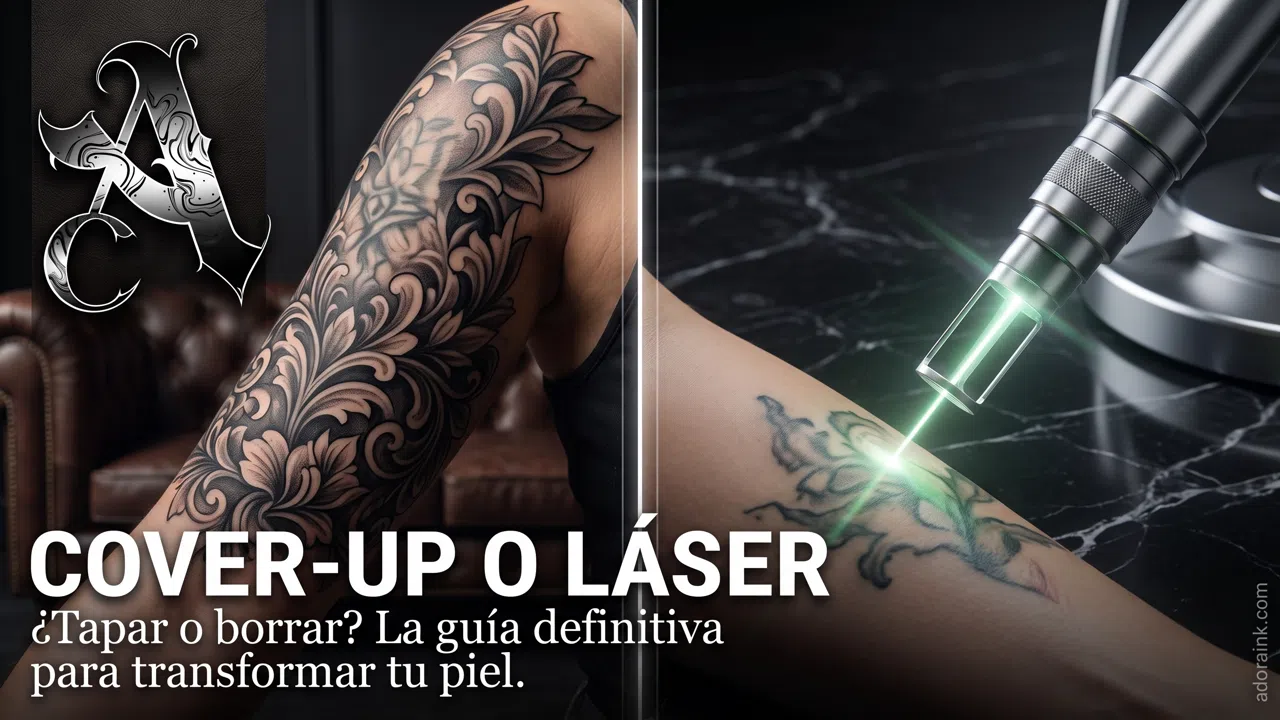
An old tattoo can sometimes be reworked, covered, lightened with laser or removed over multiple treatments. The right route depends on pigment density, colour, scarring, placement, available space and what you want to wear next. At Adora Ink in Fuenlabrada, Madrid, we assess the existing tattoo as…
An old tattoo can sometimes be reworked, covered, lightened with laser or removed over multiple treatments. The right route depends on pigment density, colour, scarring, placement, available space and what you want to wear next. At Adora Ink in Fuenlabrada, Madrid, we assess the existing tattoo as material the new plan must work with—not as an image that can be ignored.
Rework, cover-up or removal?
A rework keeps the original concept while correcting line hierarchy, contrast, colour or background. It is most realistic when the structure is still usable. A cover-up redirects the eye with a new composition and places suitable values over the old marks. Laser can pursue substantial removal or simply fade selected areas to create more options for a later cover.
Not every tattoo can be covered directly. Dense black, heavy scarring, very large shapes and pigment extending to the available boundaries may leave no room for the new design to breathe. In those cases, laser fading can reduce visual competition. Our goal is not to accept an impossible brief and hide the problem under more pigment.
A cover-up does not have to be all black
Blackwork is one useful language, not the only answer. Dark values cannot be covered by pale ink as if painting a wall, but contrast, texture, direction and selective colour can redirect attention. Florals, animals, ornamental flow, Japanese backgrounds and layered neo-traditional forms often provide useful structure. The best subject is one you genuinely want, not a random dark object chosen from a generic list of tattoo cover up ideas.
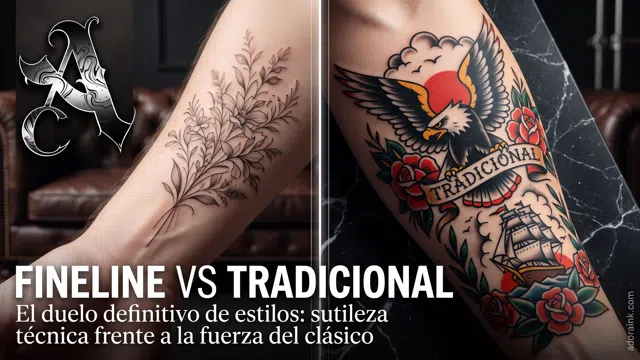
Existing lines may be incorporated into shadows, feathers, leaves, hair, fabric or background movement. Skin gaps and focal highlights should be planned around the old piece. See our style guide and fine line versus traditional comparison to understand why very delicate designs rarely conceal dense work.
Why the new tattoo is often larger
A successful cover-up commonly needs to be around 30–50% larger than the original, sometimes more. Extra space lets the artist move the focal point, create clean outer edges and establish believable contrast rather than tracing the unwanted silhouette. Exact size depends on darkness, shape and body placement; the percentage is a planning reference, not a guarantee.
A cover-up succeeds by controlling where the eye goes next, not by pretending the old pigment no longer exists.
When laser helps
Laser treatments fragment tattoo pigment so the body can gradually clear part of it. Black often responds efficiently, while certain colours and cosmetic pigments behave differently. Results vary with ink, depth, skin, device and health, and complete removal cannot be promised. Treatment should be provided by an appropriately qualified medical or laser professional after assessing risks.
For a future cover-up, total removal may be unnecessary. A few sessions can lighten the darkest lines or a specific section enough to permit a more open, colourful design. Tell both practitioners about the combined plan. After laser, wait until the skin has fully recovered—commonly 8–12 weeks, and longer if advised—before tattooing. Redness, texture change or tenderness means the area is not ready.
Consultation and skin assessment
Send clear photographs in daylight: one close view and one showing the whole body area. Include approximate dimensions, age, laser history, scars and your preferred themes. In-person assessment allows us to inspect texture and place a provisional shape. Freshly tattooed work must heal completely before any redesign decision.
Review our guides to studio hygiene, REACH-compliant pigments, aftercare and sun protection. Healthy healed skin gives both cover-up and laser planning a clearer baseline.
Style routes for transforming old work
Possible directions include a fine line rework after laser fading, black and gray tattoo cover up, realism cover-up with deep contrast, neo-traditional floral cover-up, solid blackwork tattoo transformation, watercolor rework with structured contrast, bold old-school cover-up tattoo, new-school color cover-up design, Japanese background cover-up composition, Chicano black and gray tattoo restoration, tribal tattoo redesign and extension or a saturated color tattoo cover-up. Feasibility comes from the old pigment and anatomy, not the label alone.
Build a plan you will keep
Do not rush from regret into a second compromise. Review relevant healed work, ask what must remain dark and understand the number of sessions. The pain chart and preparation guide help when the plan is ready; the convention guide is useful if considering work away from home. Explore our portfolio, learn about Adora, or book a consultation.
Frequently asked questions
Can any old tattoo be covered up directly without laser removal?
Not every tattoo. If the original piece is dense, pitch-black, and raised with scar tissue, covering it directly often leads to the old design showing through. In such cases, 2 or 3 laser sessions to lighten the dark pigment will give your artist vastly better creative freedom.
Does a cover-up tattoo have to be completely black?
No. Skillful artists use detailed textures, rich shading, and strategic color layering (deep blues, purples, emeralds, and warm dark accents) to disguise the underlying shapes without having to turn the entire area into a solid black block.
How much bigger does a cover-up tattoo need to be?
As a rule of thumb, a successful cover-up design usually needs to be at least 30% to 50% larger than the original tattoo. The extra space allows the artist to place the darkest elements over the old ink while drawing the viewer's eye away toward light, detailed outer elements.
How long must I wait after laser removal before getting a cover-up?
You should wait at least 8 to 12 weeks after your final laser removal treatment before tattooing over the area. This allows your lymphatic system to clear the broken-down ink particles and ensures the deep dermis has healed completely.