Modern Digital Stenciling: How Tablets and Thermal Printers Perfected Design Placement
Published October 2, 2026 · by Adora
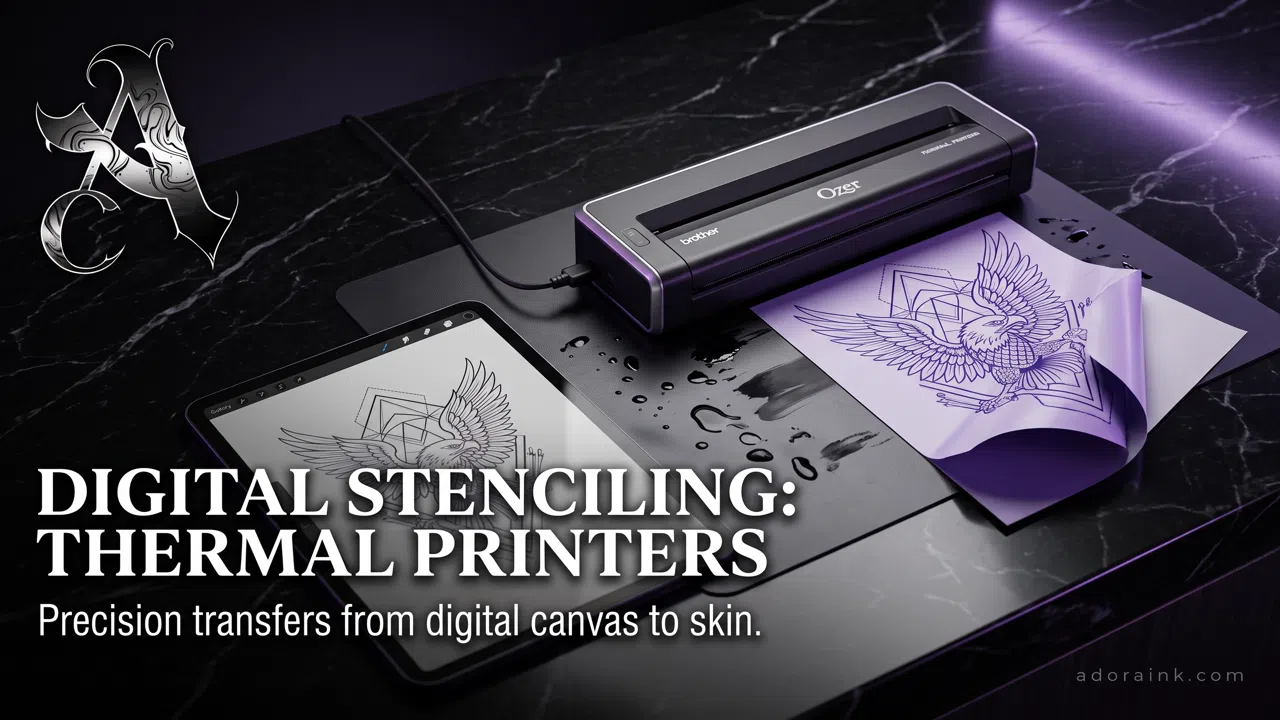
From drawing to a reliable map A tattoo stencil is a temporary roadmap, not an automatic guarantee of a good tattoo. Digital drawing tablets let an artist refine scale, symmetry, line weight, and separate layers without sacrificing the character of a hand-built design. At Adora Ink in Fuenlabrada,…
From drawing to a reliable map
A tattoo stencil is a temporary roadmap, not an automatic guarantee of a good tattoo. Digital drawing tablets let an artist refine scale, symmetry, line weight, and separate layers without sacrificing the character of a hand-built design. At Adora Ink in Fuenlabrada, Madrid, we use digital tools to prepare accurately while making the final placement decision on the client's body. Skin curves, posture, movement, and anatomy cannot be solved on a flat screen.
The process starts with a consultation and suitable references. We develop the composition, test dimensions, then prepare a stencil-ready version. A thermal printer transfers that line map onto stencil paper consistently. Professional hardware, including machines from FK Irons, supports the later tattooing stage, while compliant pigment suppliers such as World Famous Ink address a different part of the workflow. No device replaces artistic judgment.
Placement is performed on a moving body
We assess the stencil while the client stands naturally, not only while seated or lying down. Shoulders rotate, forearms twist, ribs expand, and knees bend. A motif that appears straight on paper may need optical adjustment to read correctly from normal viewing angles. We check central axes, landmarks, spacing from joints, and how the design enters and leaves sight as the body moves.
This is especially important for flowing Japanese tattoos, geometric tribal work, large blackwork, and structured Chicano designs. Tiny shifts also matter in fine-line tattooing and realism, where facial alignment or a small ellipse can change the whole image. Our style guide explains why each visual language calls for a different placement strategy.
The correct stencil is not merely centered; it feels intentional when the client stands, turns, and relaxes.
Why artists sometimes wipe and reapply
Removing a stencil before tattooing is quality control, not a failure. If the transfer wrinkles, crosses an anatomical landmark awkwardly, sits slightly off-axis, or does not satisfy the client, we clean the area and begin again. Repositioning may take several attempts. Once both artist and client approve it, we allow the transfer to set so it resists necessary wiping during the procedure.
Different aesthetics expose different placement problems. Bold old-school tattoos need readable silhouettes; neo-traditional work needs room for decorative shapes; and new-school designs often use dramatic perspective. Watercolor tattoos may combine a precise core with freer edges. Color work, black-and-grey tattoos, and delicate micro pieces all benefit from a clean underlying map.
Hygiene and stencil products
Digital does not mean contact-free. The skin is prepared hygienically, the transfer medium is dispensed without contaminating its container, and disposable materials are handled within a protected setup. Read our articles on hygiene, professional equipment, and needles. Tattoo professionals should also understand chemical compliance; the official REACH overview and our REACH ink guide provide context.
Stencil transfer products made for professional tattooing are designed for skin use, but any product can irritate an individual. Tell your artist about allergies or previous reactions. A stencil should never be improvised with unknown household chemicals. After tattooing, follow the aftercare instructions; stencil precision cannot protect a healing tattoo from friction, picking, or sun.
Style references clients often search
Collectors frequently arrive with silo phrases such as Fine line black and gray tattoo artist, Healed black and gray tattoo results, Realistic shading black and gray tattoo, High contrast black and gray tattoo studio, Black and gray tattoo cover up, Solid blackwork tattoo, Sacred geometry blackwork tattoo, Custom ornamental blackwork tattoo, Blackwork tattoo stippling shading, Award winning black and gray tattoo, Neo traditional floral tattoo sleeve, Soft edge watercolor tattoo composition, Bold traditional old school tattoo, Saturated new school color tattoo. Matching those search intents to anatomy and healed readability is part of every consultation at Adora Ink.
Digital precision without generic design
A tablet makes revision efficient, but it should not turn every tattoo into a template. We preserve line rhythm and adapt the piece to the person. This matters for a new composition and for a cover-up, where the underlying tattoo dictates scale and dark-value placement. It also helps with micro-realism, whose details need an honest assessment of what can age well.
Browse our convention guide and summer care article, then view our portfolio. To discuss dimensions and placement, contact Adora Ink or book a session. We will print, position, inspect, and reposition when necessary before making the design permanent.
Frequently asked questions
What happens if a stencil wipes away while the tattoo is in progress?
High-tack stencil prep solutions allow carbon to dry for 10–15 minutes, making it highly resistant to wiping. If light sections begin to fade mid-session, experienced artists redraw anatomical guidelines freehand using sterile, skin-safe surgical markers.
Why do I need to stand in a natural posture when the artist applies the stencil?
Skin and underlying muscles shift significantly when you sit, recline, or lean. Applying the stencil while you stand straight and relaxed guarantees the artwork will not stretch, warp, or sit off-balance during everyday movement.
Are the chemicals used in stencil transfer paper and application lotions toxic?
No. Modern thermal paper utilizes non-toxic, wax-and-carbon-based dyes. The transfer lotions used to adhere the stencil to the skin are hypoallergenic, dermatologically tested, and often contain mild antimicrobial agents.
Can an artist reposition the stencil if I dislike the initial angle or sizing?
Yes, as many times as necessary. Stencils can be wiped clean with isopropyl alcohol or specialized stencil-removal sprays without irritating the skin, allowing the artist to reposition the design until placement is exact.