EU REACH Compliant Tattoo Inks: Everything You Need to Know About Pigment Safety
Published October 2, 2026 · by Adora
What REACH means for tattoo clients European tattoo ink rules are often described online as a ban on color. That is inaccurate. REACH restricts hazardous substances and sets concentration limits for chemicals that may be carcinogenic, mutagenic, toxic to reproduction, irritating, or sensitizing.…
What REACH means for tattoo clients
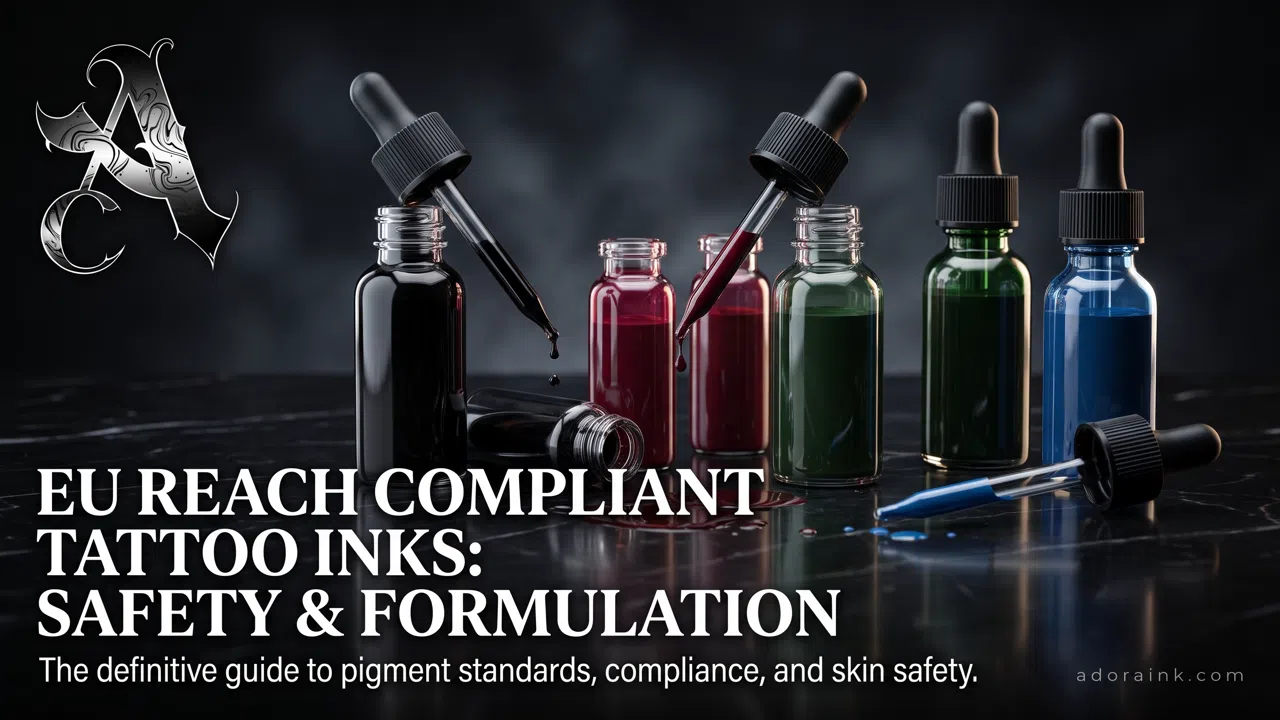
European tattoo ink rules are often described online as a ban on color. That is inaccurate. REACH restricts hazardous substances and sets concentration limits for chemicals that may be carcinogenic, mutagenic, toxic to reproduction, irritating, or sensitizing. The goal is safer pigment chemistry and better traceability, not the disappearance of colorful tattoos. The European Chemicals Agency overview explains the wider framework.
At Adora Ink in Fuenlabrada, Madrid, compliance begins before a needle touches skin. We buy sealed products from recognized distributors, inspect labels and batch details, follow storage instructions, and record the ink used during each appointment. Clients can ask to see the bottle. A professional studio should answer clearly, without hiding behind vague claims such as “organic” or “non-toxic,” which do not replace regulatory documentation.
Why some pigments changed
REACH did not declare every historic pigment dangerous. It required manufacturers to reformulate products where ingredients or impurity levels did not meet the restriction. Established suppliers such as World Famous Ink developed EU-specific compliant ranges. Reformulation can alter handling, opacity, or mixing slightly, so artists test how an ink settles and heals instead of judging only the fresh result.
A bright tattoo is created by sound color theory, contrast, saturation, placement, and healing—not by using an unverified bottle.
Modern compliant inks can produce intense reds, blues, greens, and yellows. A color tattoo may be vivid, while watercolor work can stay luminous through deliberate value structure. The bold borders of old-school tattooing, exaggerated palettes of new-school work, and layered backgrounds of Japanese tattooing remain fully achievable.
Safety is more than the bottle
Compliant pigment cannot compensate for poor practice. Single-use setup, protected surfaces, correct dilution products, clean pouring, glove changes, and suitable disposal all matter. Read our tattoo hygiene guide, equipment overview, and needle guide to understand the complete safety chain. Reliable machines from makers such as FK Irons support consistency, but technique and hygiene remain decisive.
Different styles also use pigment differently. Fine-line tattoos depend on controlled deposits; black-and-grey work uses planned dilutions; realism tattoos need smooth value transitions; and micro-realism demands restraint at tiny scale. Dense blackwork, decorative tribal tattooing, and detailed Chicano tattoos require even saturation without overworking skin. Neo-traditional pieces balance strong linework with nuanced hues.
How to verify an ink responsibly
- Look for the full product name, manufacturer, lot or batch number, expiry or minimum durability, and EU-compliance labeling.
- Confirm that the bottle is original, legible, sealed when first opened, and stored according to its instructions.
- Ask whether the studio records batch information and avoids decanting unidentified products.
- Do not treat marketplace listings, homemade mixtures, or a generic safety claim as proof.
Aftercare affects the appearance that clients sometimes blame on pigment. Follow the studio's instructions, avoid picking, and protect healed work from ultraviolet exposure. Our aftercare guide and summer care advice explain those stages. Existing work made with older ink does not automatically require intervention; consult a clinician if you have symptoms rather than assuming risk from a headline.
Style references clients often search
Collectors frequently arrive with silo phrases such as Fine line black and gray tattoo artist, Healed black and gray tattoo results, Realistic shading black and gray tattoo, High contrast black and gray tattoo studio, Black and gray tattoo cover up, Solid blackwork tattoo, Sacred geometry blackwork tattoo, Custom ornamental blackwork tattoo, Blackwork tattoo stippling shading, Award winning black and gray tattoo, Neo traditional floral tattoo sleeve, Soft edge watercolor tattoo composition, Bold traditional old school tattoo, Saturated new school color tattoo. Matching those search intents to anatomy and healed readability is part of every consultation at Adora Ink.
Choosing a transparent studio
A consultation should connect safety to design. We can discuss whether a high-contrast blackwork composition, a softer realistic approach, or a colorful solution suits the skin, placement, and long-term goal. Our articles about choosing a tattoo style, cover-ups, micro-realism, and tattoo conventions offer further context. Browse our portfolio, contact the studio, or book a session at Adora Ink.
Frequently asked questions
Are colored tattoos banned in the European Union?
No, that is a common misconception. The European Union did not ban colored tattoos; it restricted hazardous chemical stabilizers, toxic preservatives, and heavy metals found in older formulations. Global manufacturers developed brand-new, fully compliant color lines certified for EU use.
Why did the EU implement the REACH directive for tattoo pigments?
The directive aims to protect consumers from long-term health risks. It eliminates substances identified as carcinogenic, mutagenic, or toxic to human reproduction, setting stringent limits on contaminants like lead, nickel, and arsenic.
Are EU REACH compliant inks less vibrant or more prone to fading?
No. While early reformulations required adjustments in application techniques, current REACH-compliant inks match or surpass older pigments in color saturation, flow consistency, and lightfastness.
How can I verify that the ink used on my skin is safe and compliant?
Compliant ink bottles feature a visible batch code, expiration date, complete ingredient breakdown in an official EU language, and a statement confirming REACH compliance. You can request to inspect the bottle and its Material Safety Data Sheet (MSDS) prior to your session.