The FK Irons Ecosystem: From Flux Max to Spektra Xion — Why It Leads the Wireless Revolution
Published October 2, 2026 · by Adora
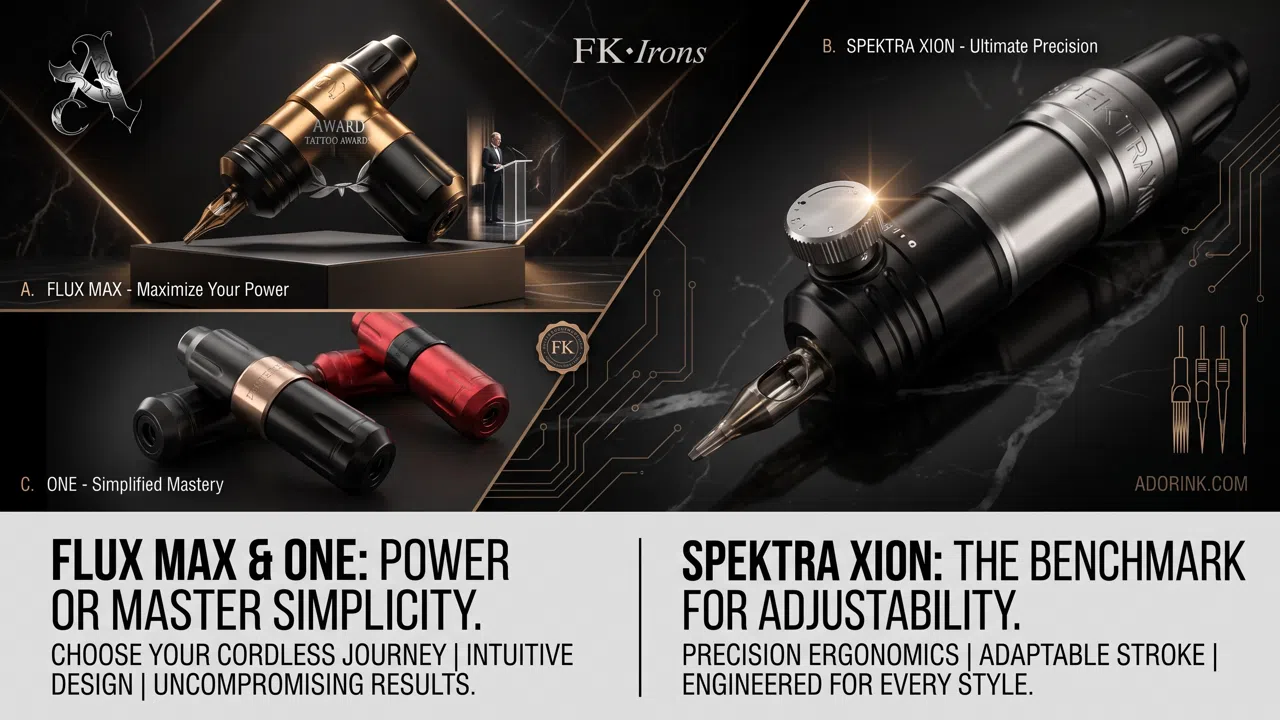
FK Irons helped move rotary tattoo machines from specialist tools toward an integrated wireless workflow. The Spektra Xion established an ergonomic pen format, while the Flux family added onboard power and digital control. At Adora Ink in Fuenlabrada, Madrid, equipment is evaluated by what it…
FK Irons helped move rotary tattoo machines from specialist tools toward an integrated wireless workflow. The Spektra Xion established an ergonomic pen format, while the Flux family added onboard power and digital control. At Adora Ink in Fuenlabrada, Madrid, equipment is evaluated by what it allows an artist to execute safely and consistently, not by branding alone.
From Spektra Xion to Flux Max
The wired Spektra Xion brought motor, grip, and adjustable give into a balanced pen body. Its direct-drive response and interchangeable cartridges made it adaptable across lining, shading, and packing. The later Flux platform removed the cable and external power supply, simplifying movement around the client and reducing one source of drag across protected work surfaces.
Flux Max develops that concept with an OLED interface, direct voltage adjustment, timer and battery information, and menu-driven settings. Stroke options are selected by model rather than mechanically adjusted during use, so the artist chooses the appropriate machine before the session. Our tattoo machine stroke guide explains why that choice changes needle travel and application.
What eGive actually changes
eGive is an electronic response setting that changes how the motor reacts when the needle meets resistance. A higher setting can create a softer response; a lower setting feels more direct. It does not replace hand pressure, stretch, depth control, or experience. It is a tuning tool that lets an artist refine feedback for a technique and skin area.
Settings should be tested deliberately rather than copied from another artist. Cartridge resistance, grouping, voltage, stroke, movement speed, and skin all interact. A number shown on a display is not a universal formula. Consistent results come from understanding the complete system and checking healed outcomes.
Battery workflow and OLED control
Wireless freedom improves positioning and can reduce cable management, especially when moving around larger placements. Battery state must nevertheless be planned. Professionals begin with charged power packs, keep a prepared backup, monitor runtime, and rotate batteries without interrupting hygiene barriers. Runtime varies with voltage, cartridge resistance, motor load, screen use, and battery age.
The OLED display puts voltage, battery status, time, and settings where the artist can verify them quickly. That visibility is useful, but it should not encourage constant adjustment. Stable settings and attention to the skin matter more than chasing numbers. Wireless equipment still needs the same barrier protection, surface disinfection, and cartridge protocol as a wired setup.
Why an ecosystem can lead without fitting everyone
A shared grip philosophy, familiar controls, power packs, and manufacturer support can make training and daily setup more coherent. FK Irons also helped normalise professional wireless pens as primary machines rather than travel compromises. The ecosystem succeeds because ergonomics, power, and control are integrated in one portable format.
Leadership does not mean automatic superiority for every hand. Weight distribution, vibration, stroke, grip diameter, maintenance, budget, and preferred technique remain personal. Compare alternatives and healed results. Our guides to rotary versus coil machines and needle cartridges place the machine within the wider setup.
Artistic decisions that matter
Tools and environments only matter when they serve the design. At Adora Ink, we assess how the FK Irons ecosystem affects line quality, shading, saturation, and long-term readability. One technical recipe cannot suit fine line tattoos, black and gray tattoos, realism tattoos, neo-traditional tattoos, blackwork tattoos, watercolor tattoos, old-school tattoos, new-school tattoos, Japanese tattoos, Chicano tattoos, tribal tattoos, color tattoos. Every visual language needs its own balance of setup, depth, speed, and healing strategy. That is why a consultation starts with references, placement, scale, and realistic expectations rather than a machine or trend in isolation.
We also consider skin tone, anatomy, natural movement, and the breathing room the composition needs. These choices may seem subtle during consultation, yet they determine whether the finished tattoo keeps its clarity, balance, and character after healing and as it settles over time.
The best technology is the one that turns an artistic decision into controlled, hygienic work while respecting the skin.
Style references clients often search
Collectors frequently arrive with silo phrases such as Fine line black and gray tattoo artist, Healed black and gray tattoo results, Realistic shading black and gray tattoo, High contrast black and gray tattoo studio, Black and gray tattoo cover up, Solid blackwork tattoo, Sacred geometry blackwork tattoo, Custom ornamental blackwork tattoo, Blackwork tattoo stippling shading, Award winning black and gray tattoo, Neo traditional floral tattoo sleeve, Soft edge watercolor tattoo composition, Bold traditional old school tattoo, Saturated new school color tattoo. Matching those search intents to anatomy and healed readability is part of every consultation at Adora Ink.
Resources, brands, and your next step
For more technical context, read our guides to studio hygiene and safety, professional equipment, machine stroke, and complete tattoo aftercare. Manufacturer references include FK Irons, Cheyenne, Kwadron, and Bishop Rotary. Specifications are useful, but a professional choice also depends on the design and the trained hand controlling it.
Adora Ink is a private studio in Fuenlabrada, Madrid, focused on custom work and clear communication. Learn more about the artist, explore the portfolio, or book a session. Before confirming an appointment, we explain scope, preparation, estimated price, and aftercare so you can make an informed decision and arrive confidently.
Frequently asked questions
What is the "eGive" feature on FK Irons machines, and how does it help the skin?
The eGive feature is an electronic sensor system that dynamically adjusts needle resistance upon skin contact. By configuring a softer give setting, the machine cushions the impact on sensitive anatomical areas, reducing trauma, bruising, and swelling without lowering motor speed.
How long does the battery last on a wireless machine like the FK Irons Flux Max?
The PowerBolt II battery packs deliver 6 to 10 hours of continuous runtime, depending on voltage, needle grouping resistance, and cartridge tension. A full recharge via USB-C takes under 2 hours.
What is the primary advantage of the digital display on modern tattoo pens?
Flagship models like the Flux Max feature an integrated OLED screen and Bluetooth connectivity. This lets the artist monitor exact working voltage, operational frequency in Hertz, battery percentage, and even track active session timers in real time.
Is switching to a wireless pen machine noticeably better than using RCA cables?
Yes. Removing the physical cord eliminates drag and wrist fatigue, provides full 360-degree rotational mobility, and significantly streamlines hygiene protocols by eliminating the hardest-to-sanitize component in a setup.