Polarized Lighting, Surgical Loupes, and Optical Tech in the Modern Tattoo Studio
Published October 2, 2026 · by Adora
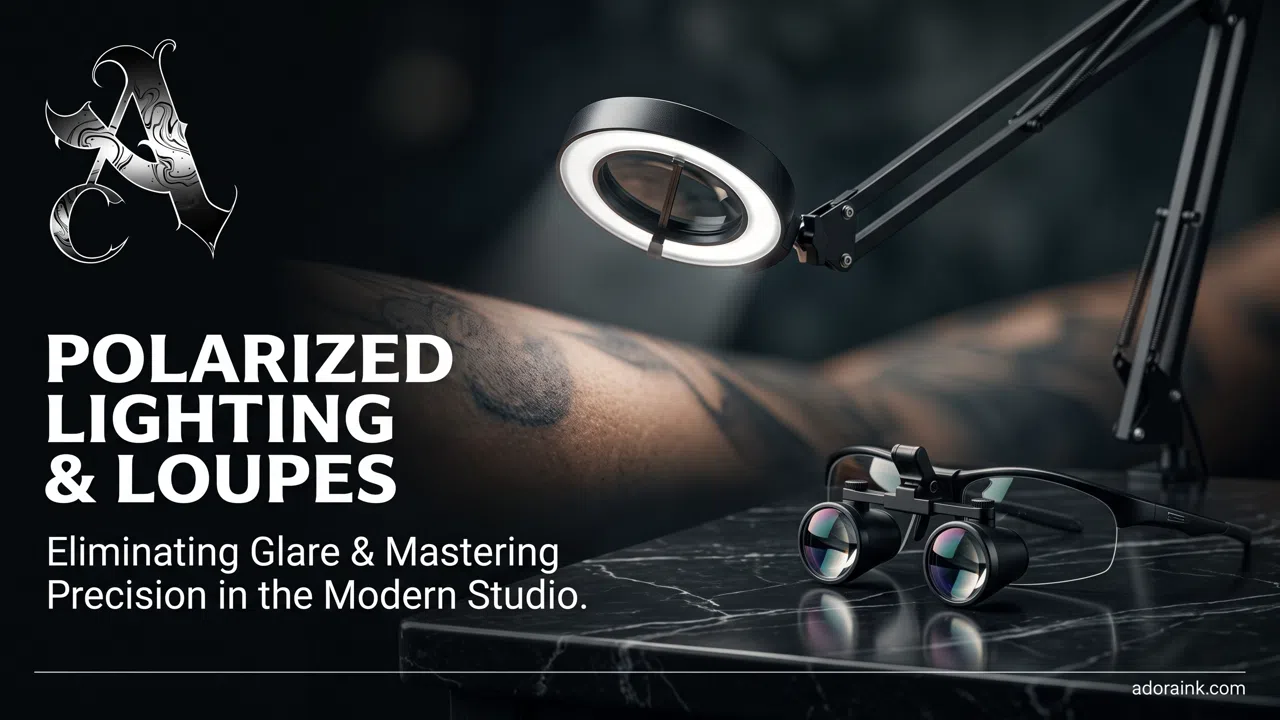
Better visibility supports better decisions Tattooing requires the artist to distinguish stencil lines, skin texture, ink saturation, swelling, and tiny changes in value for hours. Modern optical tools can make those observations clearer. At Adora Ink in Fuenlabrada, Madrid, controlled lighting and…
Better visibility supports better decisions
Tattooing requires the artist to distinguish stencil lines, skin texture, ink saturation, swelling, and tiny changes in value for hours. Modern optical tools can make those observations clearer. At Adora Ink in Fuenlabrada, Madrid, controlled lighting and magnification support precision and posture, but they never replace training, depth control, or hygiene.
A broad, neutral light reduces harsh shadows across the working area. Cross-polarization goes further: a polarizing filter on the light and another oriented filter on the viewing or camera system reduce surface glare. Because freshly tattooed skin is wet and reflective, removing specular highlights can reveal color and texture that an ordinary phone image obscures.
What polarized photographs show
Polarized images are useful documentation, but they are not identical to everyday viewing. Reduced glare can make dark values appear cleaner and saturation easier to inspect. Ethical presentation should not disguise irritation or claim that a fresh photograph is healed. Clients should compare healed work, normal-light images, and consistent editing rather than judging an artist by one dramatic studio photograph.
Accurate documentation benefits subtle black-and-grey tattoos, detailed realism, tiny fine-line work, and transitions in color tattoos. It also helps demonstrate the solid packing expected in blackwork. Our style guide explains what visual qualities to assess beyond photographic polish.
Optical technology should reveal the work more honestly, not turn a fresh tattoo into an unrealistic promise.
Surgical loupes and magnification
Loupes enlarge a limited field while maintaining a chosen working distance. Correctly fitted, they can help an artist see needle groupings, line intersections, and skin response without repeatedly leaning forward. That may support a more neutral neck and back posture during precision work. Excessive magnification, an unsuitable working distance, or a narrow field can be counterproductive, so loupes require fitting and adaptation.
Magnification is particularly relevant for micro-realism, yet it does not make every tiny idea durable. The artist must still simplify detail for ageing. It can assist decorative edges in neo-traditional work, dense patterns in tribal tattoos, portrait accents in Chicano tattooing, and controlled shapes in Japanese compositions.
Why phone photos can look too red
Phones automatically change white balance, exposure, contrast, and saturation. Warm lamps, mixed daylight, surrounding colors, and inflammation can produce an exaggerated red or orange cast. The solution is not to diagnose healing from a photograph. We use consistent neutral lighting where possible and interpret the skin in person. Increasing heat, spreading redness, discharge, worsening pain, fever, or other concerning symptoms require appropriate medical advice.
Lighting improves observation but cannot improve healing by itself. Healing depends on controlled technique, hygiene, the client's health, and aftercare. Read our hygiene article, aftercare guide, and summer care advice. Reliable equipment such as systems from FK Irons and documented pigments from suppliers including World Famous Ink are parts of a wider professional process.
Tools for every visual language
Clear light supports bold outlines in old-school tattooing, exaggerated forms in new-school designs, and transparent-looking overlaps in watercolor tattoos. The tool changes what the artist can see, not the biological limit of the skin. We use it to make measured choices and stop before unnecessary trauma.
For more context, explore our guides to professional equipment, needles, cover-ups, and conventions. Pigment safety is covered in our REACH article and by the official ECHA overview.
Style references clients often search
Collectors frequently arrive with silo phrases such as Fine line black and gray tattoo artist, Healed black and gray tattoo results, Realistic shading black and gray tattoo, High contrast black and gray tattoo studio, Black and gray tattoo cover up, Solid blackwork tattoo, Sacred geometry blackwork tattoo, Custom ornamental blackwork tattoo, Blackwork tattoo stippling shading, Award winning black and gray tattoo, Neo traditional floral tattoo sleeve, Soft edge watercolor tattoo composition, Bold traditional old school tattoo, Saturated new school color tattoo. Matching those search intents to anatomy and healed readability is part of every consultation at Adora Ink.
See the work in context
A portfolio should include consistent, well-framed examples and, ideally, healed outcomes. Browse our portfolio, then contact Adora Ink to discuss a design or book a session. Technology can help us see and document more clearly; the lasting result still comes from design, technique, skin care, and honest expectations.
Frequently asked questions
Why do tattooers use specialized polarized lights and filters when photographing new tattoos?
Freshly tattooed skin is naturally inflamed, reddish, and coated with protective ointments, creating harsh white glare under normal lighting. Cross-polarization filters eliminate surface glare entirely, showing accurate ink saturation and fine line details beneath the surface.
Do surgical loupes improve the physical quality of a tattoo?
Yes. For micro-realism, fine lettering, and delicate fineline work, medical loupes provide 2.5× to 4× optical magnification. This allows the artist to monitor exact needle depth and pigment dispersal down to fractions of a millimeter.
Why do fresh tattoos appear more red in photos taken on standard phone cameras?
Needle punctures trigger localized capillary blood flow (erythema). Smartphone camera sensors tend to over-saturate reds and warm values under warm ambient studio lights, making high-CRI (95+) neutral daylight lamps essential for accurate photos.
Does proper workstation lighting affect how well a tattoo heals?
Indirectly, yes. Shadowless, balanced task lighting prevents eye strain and allows the artist to see pigment saturation on the first pass, avoiding unnecessary repeated needle passes that cause skin trauma and prolonged healing.