Top Professional Tattoo Equipment & Ink Brands: What Quality Inks Look Like
Published October 2, 2026 · by Adora
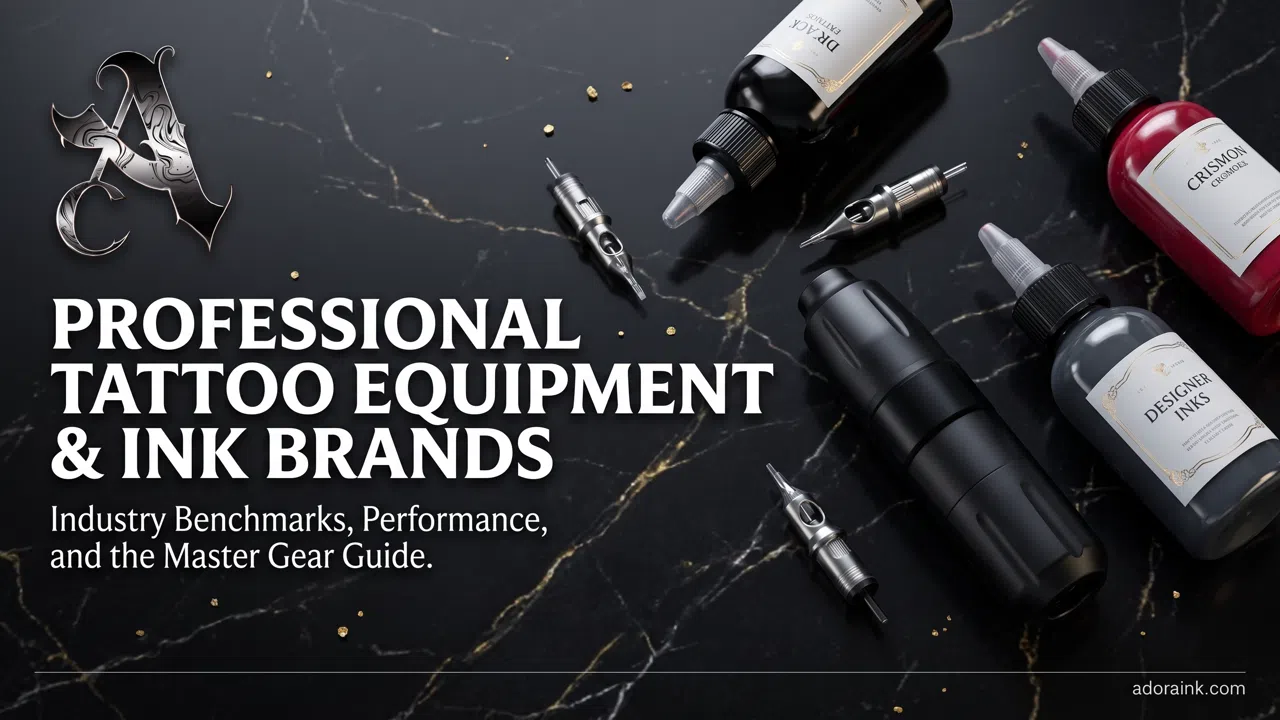
Professional equipment is not defined by price or social-media popularity. A tattoo system must provide predictable motion, ergonomic control, cleanable or barrier-compatible surfaces, reliable sterile consumables, and traceable pigments. At Adora Ink in Fuenlabrada, Madrid, brands are evaluated as…
Professional equipment is not defined by price or social-media popularity. A tattoo system must provide predictable motion, ergonomic control, cleanable or barrier-compatible surfaces, reliable sterile consumables, and traceable pigments. At Adora Ink in Fuenlabrada, Madrid, brands are evaluated as tools within a complete workflow; technique, hygiene, design, and healing remain decisive.
What makes a machine professional?
A dependable machine starts consistently, maintains its output under load, holds cartridges securely, and allows the artist to work without excessive vibration or fatigue. Weight distribution matters during long sessions. So do battery behavior, voltage adjustment, service support, replacement parts, and a shape that can be barrier-wrapped correctly.
Established manufacturers such as FK Irons, Cheyenne, and Bishop Rotary offer different strokes, motors, grips, and power ecosystems. Our article on the FK Irons Flux Max and Spektra Xion examines one ecosystem. Specifications help comparison, but the artist must understand how each machine behaves with their hand speed and needle choice.
Rotary versus coil
Rotary machines use a motor to create needle movement. Modern pen formats are compact, relatively quiet, and easy to maneuver; fixed or adjustable stroke options can cover line, shading, and packing. Coil machines use electromagnetic coils and springs. They offer tactile feedback, tunable give, and a characteristic hit, but tend to be heavier, louder, and more maintenance-intensive.
Neither technology guarantees better tattoos. A well-tuned coil in an experienced hand can be exceptional, as can a balanced rotary. The practical choice concerns response, weight, serviceability, preferred techniques, and session format. Read the machine stroke guide to understand why a 3.0 mm and 4.2 mm setup feel different.
Cartridges, power, and supporting equipment
Sterile single-use cartridges should have intact packs, clear lot and expiry details, consistent needle soldering or alignment, and an effective membrane compatible with the machine. Suppliers such as Kwadron publish configurations and diameters. The artist chooses liners, shaders, magnums, taper, and diameter according to the mark—not because one grouping is “best.”
Power supplies and batteries must deliver stable output and permit controlled adjustments. Furniture, lighting, arm supports, thermal stencil equipment, rinse products, barriers, and sharps containers are equally important. A premium pen on an unsafe workstation is not a professional setup. Review our studio hygiene standards.
What quality tattoo ink looks like
Quality pigment arrives in an original sealed bottle with manufacturer identity, product name, ingredients, batch or lot number, expiry or minimum durability, storage guidance, and regionally required compliance information. In the EU, tattoo mixtures must meet REACH restrictions. The European Chemicals Agency explains the framework, and our REACH ink guide covers tattoo-specific implications.
Manufacturers such as World Famous Ink offer EU-compliant ranges. The bottle should be purchased through an authorized supply chain and stored as directed. Terms such as organic, natural, or non-toxic are not substitutes for legal labeling and traceability.
Why old tattoos may look blue or green
Older black tattoos can shift visually because pigment particles change and disperse, the skin above them changes with age, and sunlight breaks down colorants. Historic black formulas sometimes had undertones that became more visible as density softened. Application depth and repeated UV exposure also influence appearance. Modern quality black and sound technique improve consistency, but no tattoo is frozen in time.
Vegan ink: useful claim, limited scope
Vegan ink generally means no intentionally animal-derived ingredients such as bone char, shellac, gelatin, or animal glycerin. It does not automatically prove REACH compliance, sterility, allergy safety, or permanence. Clients seeking vegan products should ask for manufacturer documentation and confirm related stencil and aftercare products too.
A respected logo can support consistency, but quality is verified through the label, supply chain, setup, technique, and healed result.
Match tools to style
Fine line benefits from controlled movement; realism needs stable tonal layering; blackwork requires efficient saturation; color work depends on deliberate pigment selection. Explore our tattoo styles guide. Whatever the method, follow the complete aftercare guide so avoidable healing damage is not mistaken for equipment failure.
Equipment serving specific outcomes
Technical setups should serve goals such as Fine line black and gray tattoo artist, Healed black and gray tattoo results, Solid blackwork tattoo, Sacred geometry blackwork tattoo, Custom ornamental blackwork tattoo, Black and gray tattoo cover up, Realistic shading black and gray tattoo, High contrast black and gray tattoo studio, Blackwork tattoo stippling shading, Award winning black and gray tattoo, Soft edge watercolor tattoo composition, and Neo traditional floral tattoo sleeve. No single machine or ink formula optimizes all of them.
Choose evidence over brand lists
Ask to see sealed consumables and labeled ink, then judge the artist through healed work and clear safety answers. Browse our portfolio, learn about Adora, contact the studio, or book a session to discuss the right technical approach for your idea.
Frequently asked questions
Why do some older tattoos turn blue or green over time?
Older or low-grade inks often used heavy iron oxides or coarse industrial pigments that degraded under UV light into blue/green base tones. Modern professional black inks use pure carbon-black formulations that maintain neutral, deep tones as they age.
What does "EU REACH compliant" mean for tattoo ink?
REACH is a strict European chemical safety regulation that bans hazardous preservatives, heavy metals, and carcinogenic aromatic amines in tattoo pigments. Compliant inks undergo rigorous toxicological safety testing before hitting the market.
Are rotary machines better than traditional coil machines?
Neither is universally "better," but rotary machines have become the industry standard due to their smooth brushless motors, lighter weight, reduced vibration, compatibility with disposable safety cartridges, and gentle impact on the skin.
Is vegan tattoo ink truly cruelty-free and safe?
Yes. Most top-tier modern inks are 100% vegan. They substitute traditional animal by-products (such as bone char or animal glycerin) with pure vegetable glycerin and mineral/synthetic carbon pigments, making them hypoallergenic and cleaner for the skin.