Restorative Tattooing: Camouflaging Scars, Stretch Marks, and 3D Areola Reconstruction
Published October 2, 2026 · by Adora
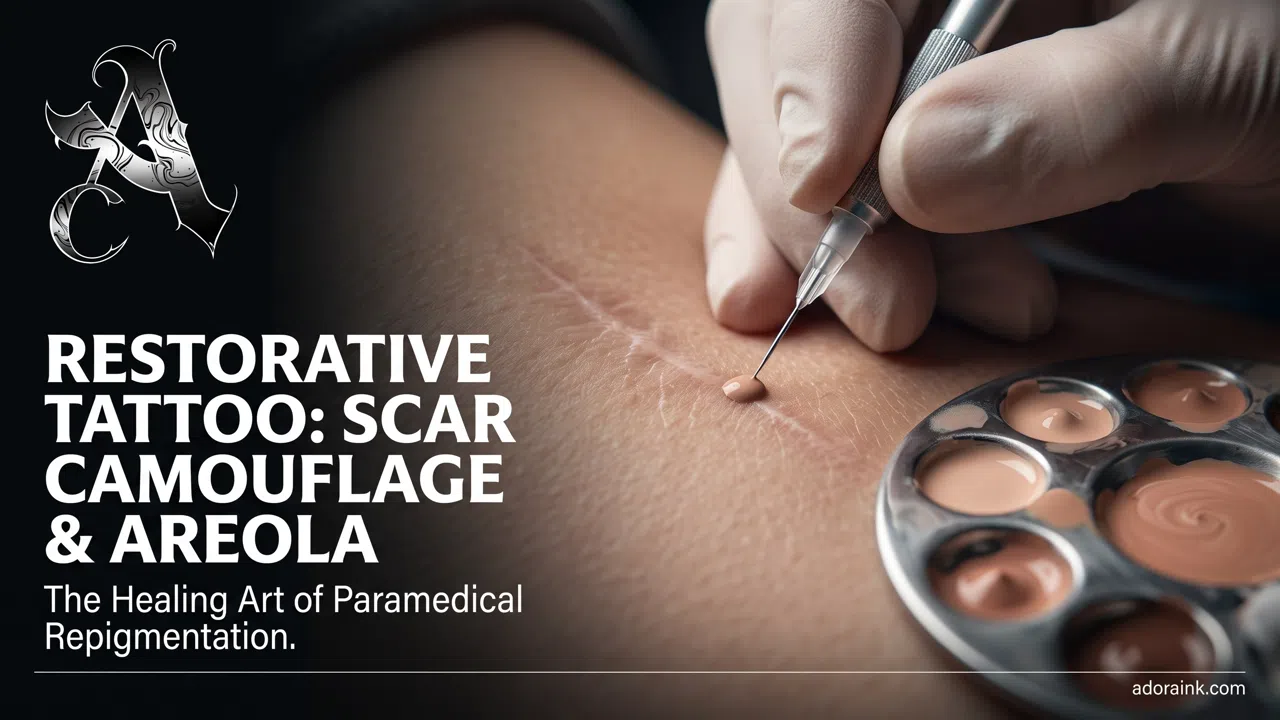
What restorative tattooing can achieve Restorative tattooing uses pigment and design to reduce visual contrast, redirect attention, or recreate an anatomical feature. It can include decorative tattoos over mature scars, paramedical color camouflage, and three-dimensional areola imagery after breast…
What restorative tattooing can achieve
Restorative tattooing uses pigment and design to reduce visual contrast, redirect attention, or recreate an anatomical feature. It can include decorative tattoos over mature scars, paramedical color camouflage, and three-dimensional areola imagery after breast surgery. It cannot erase texture, guarantee an exact skin-color match, or replace medical treatment. At Adora Ink in Fuenlabrada, Madrid, an honest assessment comes before any promise.
Every scar behaves differently. Cause, depth, location, mobility, blood supply, texture, color, previous treatment, and personal healing history affect the plan. Flat pale scars may accept pigment differently from raised, red, tight, or indented tissue. Stretch marks are a form of dermal scarring and can vary within the same area. We never assume that a technique suitable for normal skin will behave identically on altered tissue.
Waiting until tissue is mature
A scar should be fully closed and mature before tattooing. Twelve months is a common minimum reference, but some surgical or traumatic scars need eighteen months or longer. Persistent redness, tenderness, itching, firmness, change, or ongoing treatment means the area needs more time and possibly medical clearance. The treating surgeon or dermatologist—not a tattoo artist—decides whether a medical condition is stable.
Restorative work is successful when timing, expectations, design, and tissue condition are all respected.
Consultation includes medical history relevant to healing, medications, tendency toward hypertrophic or keloid scars, radiation history, sensation changes, and the client's objective. Tattooing must not be performed over active infection, unexplained lesions, or unstable tissue. Our hygiene guide and aftercare guide explain the broader safety framework.
Camouflage versus decorative concealment
Skin-tone camouflage aims to reduce color difference by layering a carefully chosen pigment. Results can shift with tanning, natural skin changes, circulation, and pigment ageing, so a perfect permanent match is unrealistic. Decorative concealment uses the artwork itself to guide the eye. Organic leaves, petals, textures, shadows, and planned negative space can incorporate the scar rather than pretending it is absent.
Different visual languages offer different tools. Soft black-and-grey work can redirect value; realism can integrate natural forms; and fine-line designs may suit stable, flat tissue when spacing remains generous. Watercolor tattoos use movement, while color work creates deliberate focal points. Dense blackwork can conceal contrast but is not appropriate for every scar.
Designing around texture and movement
Bold old-school motifs, layered neo-traditional pieces, and energetic new-school designs provide strong shape control. Flowing Japanese compositions can follow long surgical lines, while ornamental tribal work requires careful alignment with raised texture. Chicano tattooing can use portraiture, lettering, and smoke to distribute attention. The best approach is the one adapted to the actual tissue, not a style chosen solely because it covered someone else's scar online.
Scar tissue may be numb, hypersensitive, tight, or intermittently painful. Some clients feel less than on normal skin; others feel more. Sensation can also change within a few centimeters. We work conservatively and stop if the tissue response is unsuitable. Professional equipment, including systems from FK Irons, supports control but cannot normalize scar biology.
3D areola reconstruction
Three-dimensional areola tattooing uses color, edges, highlights, shadows, and asymmetry to create an optical impression of projection. Planning considers position, diameter, counterpart matching, surgical shape, skin tone, and the client's preference. This sensitive service should be trauma-informed, private, and never rushed. Medical approval may be appropriate after surgery, radiation, or complications.
We use documented EU-compliant pigments from professional sources such as World Famous Ink within the REACH framework. Read our REACH guide, equipment article, and needle guide for additional context.
Style references clients often search
Collectors frequently arrive with silo phrases such as Fine line black and gray tattoo artist, Healed black and gray tattoo results, Realistic shading black and gray tattoo, High contrast black and gray tattoo studio, Black and gray tattoo cover up, Solid blackwork tattoo, Sacred geometry blackwork tattoo, Custom ornamental blackwork tattoo, Blackwork tattoo stippling shading, Award winning black and gray tattoo, Neo traditional floral tattoo sleeve, Soft edge watercolor tattoo composition, Bold traditional old school tattoo, Iconic black and grey Chicano tattoo. Matching those search intents to anatomy and healed readability is part of every consultation at Adora Ink.
Planning a realistic outcome
More than one session may be needed because altered tissue can retain pigment unevenly. Touch-ups are assessed only after complete healing. Sun exposure changes surrounding skin and can increase mismatch, so follow our summer care guidance. The principles in our cover-up guide, micro-realism article, style guide, and convention guide can help set expectations.
Explore our portfolio. For a private assessment, contact Adora Ink with the scar's age and relevant history, or book a consultation. We will advise whether tattooing is suitable now, should be postponed, or requires medical input first.
Frequently asked questions
How long must I wait before tattooing over a surgical scar?
A scar must be completely mature, a process that takes between 12 and 24 months. The tissue needs to be stable, flattened, and fully faded to a pale or silvery white, showing no residual vascular redness or active inflammation.
Does tattooing over scar tissue hurt more than regular skin?
Pain levels vary based on underlying nerve integrity. If superficial sensory nerves were severed during surgery, the scar site may feel relatively numb; conversely, if nerve regeneration led to localized hypersensitivity, it can feel sharper than untouched skin.
What styles of art work best for concealing uneven or raised scars?
Organic, fluid compositions—such as botanical florals, leafy vines, waves, smoke, and soft-feathered animal textures. Rigid geometric frameworks and straight lines draw the eye toward surface irregularities rather than disguising them.
Can stretch marks be permanently covered or camouflaged with tattooing?
Yes, mature stretch marks that are pale and white can either be blended using custom skin-tone micropigmentation pigments or integrated into a larger artistic decorative piece. Red, pink, or purplish stretch marks are still actively healing and cannot yet be treated.