Wireless Rotary Pens vs. Traditional Coil Machines: The Evolution That Changed Tattooing
Published October 2, 2026 · by Adora
Wireless rotary pens changed the physical workflow of tattooing by combining motor, grip, controls, and battery in one compact body. Traditional coil machines remain mechanically expressive and professionally relevant. At Adora Ink in Fuenlabrada, Madrid, the useful comparison is not old versus…
Wireless rotary pens changed the physical workflow of tattooing by combining motor, grip, controls, and battery in one compact body. Traditional coil machines remain mechanically expressive and professionally relevant. At Adora Ink in Fuenlabrada, Madrid, the useful comparison is not old versus new, but how each system delivers pigment, feels in the hand, and fits hygienic practice.
How the mechanisms differ
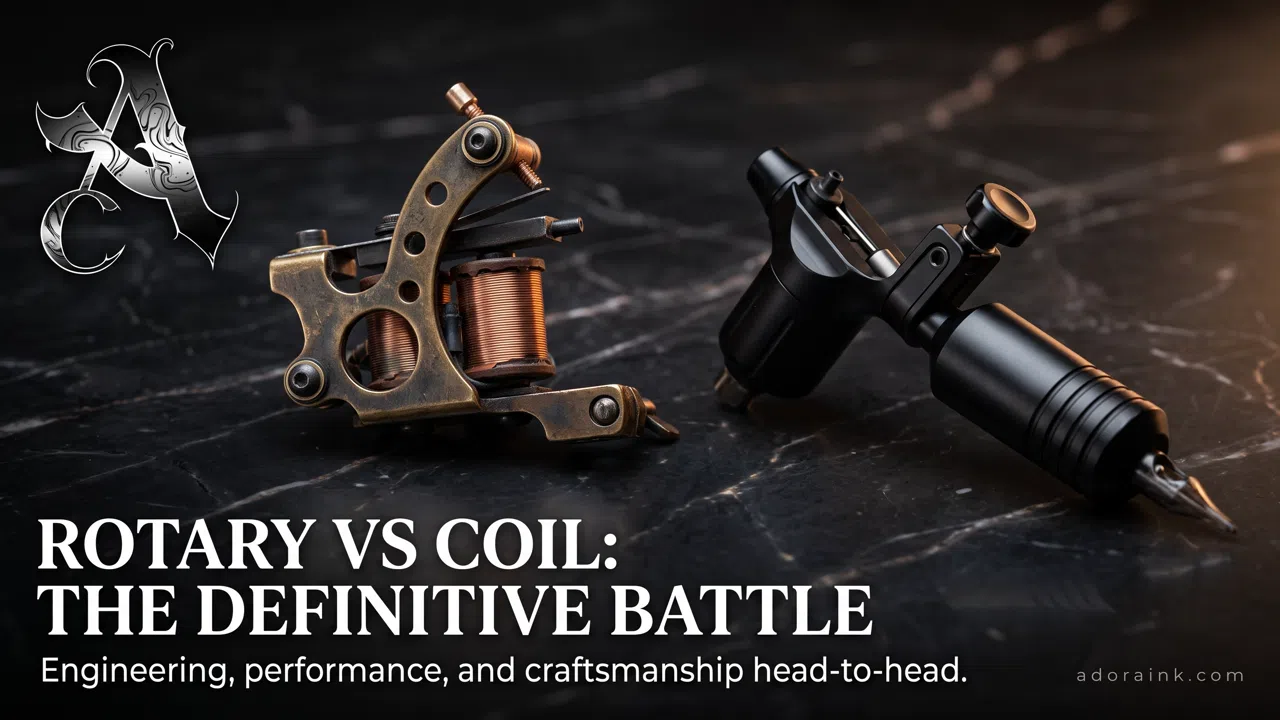
A coil machine uses electromagnetic coils to pull an armature bar, opening and closing a contact circuit that drives the needle. Spring tension, contact gap, voltage, weight, and geometry shape its hit. A rotary converts motor rotation into needle movement through a cam or drive mechanism, generally producing a more continuous cycle.
A wireless pen packages the rotary drive with a cartridge grip and battery. It removes clip cord and separate power supply from immediate movement, although charging and backup planning become essential. For stroke implications, see our machine stroke guide.
Noise, feel, and why coils remain
Rotaries are usually quieter because they lack the rapid electromagnetic contact action of coils. Lower noise can make conversation and long sessions feel calmer. Noise level does not measure tattoo quality. Motor vibration, cartridge tension, weight distribution, and grip still affect comfort for artist and client.
Coils remain in use because experienced artists value their tunable mechanical response, feedback, serviceability, and specialised behaviour for lining or packing. Some prefer the balance and audible rhythm developed through years of practice. A well-tuned coil is not obsolete; it is a different system with cables, more components, and a learning curve.
Skin trauma is about application
Rotaries are often described as gentler because their motion can feel smooth and consistent. That does not guarantee less trauma. Excessive depth, slow hand speed, unsuitable stroke, high voltage, repeated passes, poor stretch, or an inappropriate grouping can damage skin with any machine. Coils can also be used efficiently by a trained artist.
The responsible goal is effective pigment placement with the minimum passes needed, followed by observation of redness, swelling, and skin response. Healed work is the real measure. Machine type is one variable among design, technique, cartridge or needle, pigment, body area, client condition, and aftercare.
Disinfection and barrier control
Neither wireless nor wired equipment is inherently sterile. Reusable surfaces must be cleaned and disinfected according to their materials and manufacturer instructions, while parts that cannot be disinfected appropriately are protected with single-use barriers. Batteries, controls, grips, cables, power supplies, bottles, and work surfaces need a planned clean-to-dirty workflow.
Coil setups require barriers around machine and cable and correct processing of reusable tubes when used. Cartridge pens require compatible safety membranes, machine sleeves, protected battery controls, and proper sharps disposal. Wireless convenience reduces a cable, not infection-control responsibilities. Review our studio hygiene guide.
Artistic decisions that matter
Tools and environments only matter when they serve the design. At Adora Ink, we assess how machine choice affects line quality, shading, saturation, and long-term readability. One technical recipe cannot suit fine line tattoos, black and gray tattoos, realism tattoos, neo-traditional tattoos, blackwork tattoos, watercolor tattoos, old-school tattoos, new-school tattoos, Japanese tattoos, Chicano tattoos, tribal tattoos, color tattoos. Every visual language needs its own balance of setup, depth, speed, and healing strategy. That is why a consultation starts with references, placement, scale, and realistic expectations rather than a machine or trend in isolation.
We also consider skin tone, anatomy, natural movement, and the breathing room the composition needs. These choices may seem subtle during consultation, yet they determine whether the finished tattoo keeps its clarity, balance, and character after healing and as it settles over time.
The best technology is the one that turns an artistic decision into controlled, hygienic work while respecting the skin.
Style references clients often search
Collectors frequently arrive with silo phrases such as Fine line black and gray tattoo artist, Healed black and gray tattoo results, Realistic shading black and gray tattoo, High contrast black and gray tattoo studio, Black and gray tattoo cover up, Solid blackwork tattoo, Sacred geometry blackwork tattoo, Custom ornamental blackwork tattoo, Blackwork tattoo stippling shading, Award winning black and gray tattoo, Neo traditional floral tattoo sleeve, Soft edge watercolor tattoo composition, Bold traditional old school tattoo, Saturated new school color tattoo. Matching those search intents to anatomy and healed readability is part of every consultation at Adora Ink.
Resources, brands, and your next step
For more technical context, read our guides to studio hygiene and safety, professional equipment, machine stroke, and complete tattoo aftercare. Manufacturer references include FK Irons, Cheyenne, Kwadron, and Bishop Rotary. Specifications are useful, but a professional choice also depends on the design and the trained hand controlling it.
Adora Ink is a private studio in Fuenlabrada, Madrid, focused on custom work and clear communication. Learn more about the artist, explore the portfolio, or book a session. Before confirming an appointment, we explain scope, preparation, estimated price, and aftercare so you can make an informed decision and arrive confidently.
Frequently asked questions
Do modern tattoo artists still use traditional coil machines?
Yes, though far less frequently. Some artists dedicated to bold American Traditional or heavy single-pass linework prefer the punch and mechanical rhythm of coils. However, most modern studios have adopted rotary pens for their versatility.
Why do rotary pen machines produce less noise and vibration?
Rotary pens rely on compact electric brushless motors that convert rotational force directly into linear needle movement. They eliminate the loud, violent vibration caused by electromagnetic contact bars slamming open and closed thousands of times per minute.
Do wireless rotary machines cause less skin trauma than coils?
Generally, yes. The consistent motor speed and linear cartridge stability minimize needle wobble and skin snags. This creates cleaner punctures, reducing surface irritation, scabbing, and post-session redness.
How are wireless battery-powered pens safely disinfected?
Battery units and motor housings cannot be submerged in chemical baths or autoclaved. Instead, they are wrapped in disposable plastic barrier sleeves for every session, followed by surface disinfection with hospital-grade, broad-spectrum medical wipes.