Tattoo Needle Cartridges Explained: Safety Membranes, Taper Lengths, and Groupings
Published October 2, 2026 · by Adora
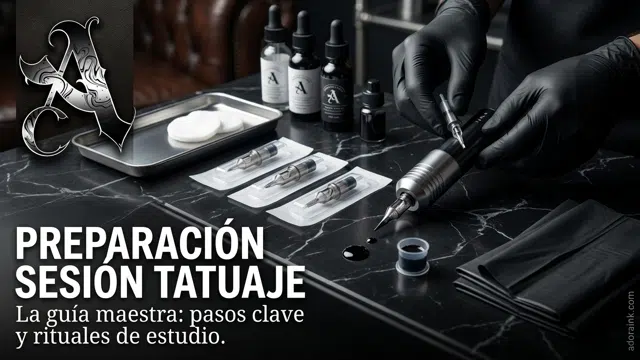
A cartridge combines a needle grouping, tip, casing, and internal mechanism in one removable module. It makes configuration changes efficient, but compatibility does not guarantee equal quality or safety. At Adora Ink in Fuenlabrada, Madrid, cartridges are selected according to the mark required,…
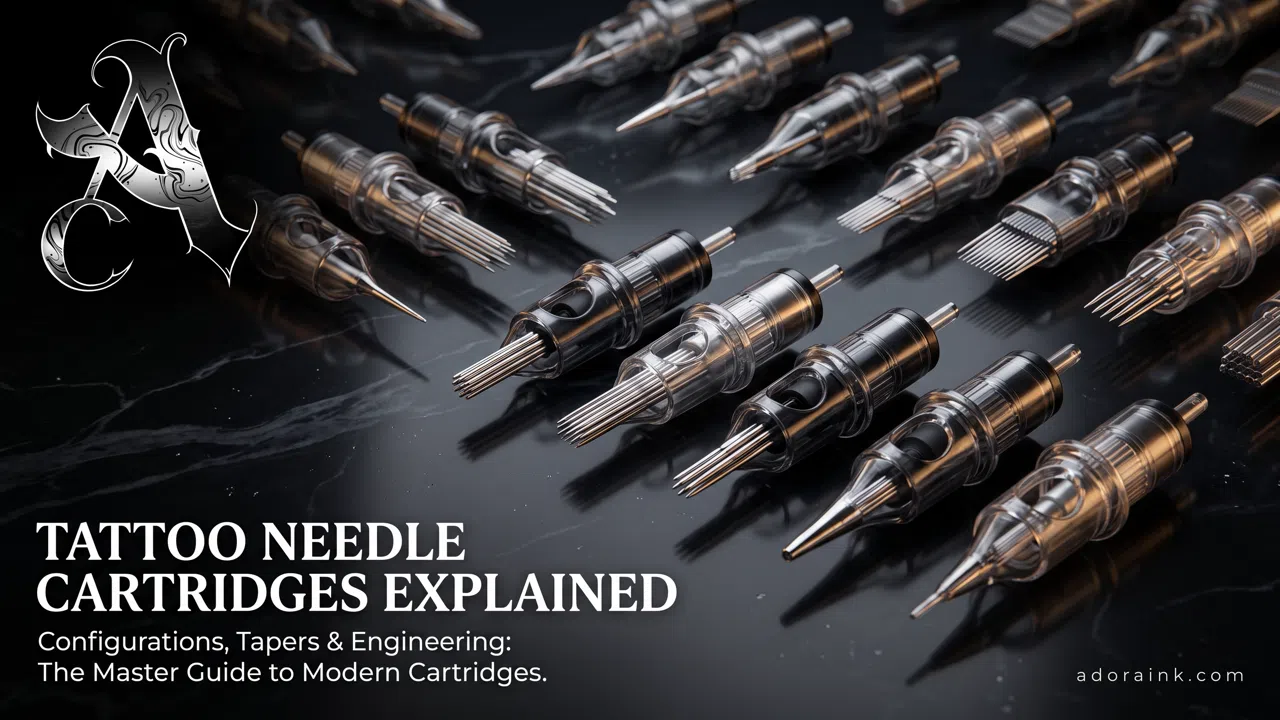
A cartridge combines a needle grouping, tip, casing, and internal mechanism in one removable module. It makes configuration changes efficient, but compatibility does not guarantee equal quality or safety. At Adora Ink in Fuenlabrada, Madrid, cartridges are selected according to the mark required, the machine, the skin, and a strict single-use protocol.
The safety membrane
A cartridge membrane forms a barrier intended to reduce fluid travelling back toward the grip and drive system. Professionals verify that both cartridge and machine are compatible with membrane cartridges. The membrane supports infection control, but it never replaces wrapping the machine, protecting surfaces, hand hygiene, gloves, and correct disposal.
Each cartridge is sterile, sealed, within date, and opened for one client. It is discarded immediately after use in an approved sharps container. Damaged packaging, uncertain origin, or reuse is unacceptable. Read more in our hygiene and safety guide.
Taper length and ink delivery
Taper describes how gradually the needle narrows toward its point. A long taper has an extended, finer transition and can support controlled, delicate deposits used in smooth shading or precise line work. Shorter tapers can feel more assertive and deliver pigment differently. Neither is inherently better; technique and intended mark determine the choice.
Taper is only one variable. Needle diameter, count, arrangement, tip geometry, tension, machine stroke, voltage, hand speed, depth, and skin response work together. Marketing labels also vary among manufacturers, so professionals inspect specifications and test responsibly rather than treating a name as a guaranteed outcome.
Groupings, diameters, and bugpins
Round liners concentrate needles for lines; round shaders spread them more openly. Magnums place needles in rows for shading and packing, with curved magnums softening the outer contact. Flats serve particular geometric or packing approaches. The number indicates needle count, while configuration describes arrangement.
Bugpin commonly refers to a smaller needle diameter than a standard equivalent, often around 0.25 mm rather than 0.30 or 0.35 mm, although labels must be checked. It can create refined marks and smooth transitions, but does not automatically make a tattoo safer, painless, or more detailed. Fine components still require disciplined depth and spacing.
Why artists switch cartridges
One design may require a liner for structure, a curved magnum for gradients, and another grouping for saturation. Switching a sterile cartridge lets the artist change mark efficiently without dedicating a complete machine to every task. Each used unit remains contaminated and must never return to storage or another client.
The artist also changes a cartridge if performance becomes inconsistent, the needle is damaged, or a different diameter and taper better suits the next passage. Cartridge choice should follow the visual plan. See how this connects to fine line versus traditional tattoos and professional equipment.
Artistic decisions that matter
Tools and environments only matter when they serve the design. At Adora Ink, we assess how needle cartridge selection affects line quality, shading, saturation, and long-term readability. One technical recipe cannot suit fine line tattoos, black and gray tattoos, realism tattoos, neo-traditional tattoos, blackwork tattoos, watercolor tattoos, old-school tattoos, new-school tattoos, Japanese tattoos, Chicano tattoos, tribal tattoos, color tattoos. Every visual language needs its own balance of setup, depth, speed, and healing strategy. That is why a consultation starts with references, placement, scale, and realistic expectations rather than a machine or trend in isolation.
We also consider skin tone, anatomy, natural movement, and the breathing room the composition needs. These choices may seem subtle during consultation, yet they determine whether the finished tattoo keeps its clarity, balance, and character after healing and as it settles over time.
The best technology is the one that turns an artistic decision into controlled, hygienic work while respecting the skin.
Style references clients often search
Collectors frequently arrive with silo phrases such as Fine line black and gray tattoo artist, Healed black and gray tattoo results, Realistic shading black and gray tattoo, High contrast black and gray tattoo studio, Black and gray tattoo cover up, Solid blackwork tattoo, Sacred geometry blackwork tattoo, Custom ornamental blackwork tattoo, Blackwork tattoo stippling shading, Award winning black and gray tattoo, Neo traditional floral tattoo sleeve, Soft edge watercolor tattoo composition, Bold traditional old school tattoo, Saturated new school color tattoo. Matching those search intents to anatomy and healed readability is part of every consultation at Adora Ink.
Resources, brands, and your next step
For more technical context, read our guides to studio hygiene and safety, professional equipment, machine stroke, and complete tattoo aftercare. Manufacturer references include FK Irons, Cheyenne, Kwadron, and Bishop Rotary. Specifications are useful, but a professional choice also depends on the design and the trained hand controlling it.
Adora Ink is a private studio in Fuenlabrada, Madrid, focused on custom work and clear communication. Learn more about the artist, explore the portfolio, or book a session. Before confirming an appointment, we explain scope, preparation, estimated price, and aftercare so you can make an informed decision and arrive confidently.
Frequently asked questions
Why is a built-in safety membrane essential on a needle cartridge?
The elastic silicone membrane creates a hermetic seal at the rear of the cartridge. It acts as an absolute physical barrier that prevents blood, interstitial fluid, and ink from flowing back into the machine motor, eliminating cross-contamination between clients.
What does "Long Taper" mean, and what is it used for?
Taper refers to the length of the sharpened point on each needle pin. A Long Taper needle tapers gradually toward an ultra-fine point, creating smaller micro-punctures. This makes it ideal for soft black-and-grey shading, smooth transitions, and high-detail work.
What are "Bugpin" tattoo needles?
Bugpin needles use ultra-thin wire diameters (typically 0.20 mm or 0.25 mm compared to the standard 0.35 mm). Because the individual pins sit closer together, they allow for exceptionally delicate dotwork, fine line precision, and smooth pixel shading.
Why does an artist switch cartridges multiple times during one session?
Different phases of a tattoo require distinct needle configurations (tight round liners for crisp outlines, round shaders for transitions, and wide magnums for solid ink saturation). Additionally, needles dull after hours of contact with dense skin and are swapped out to maintain clean, atraumatic incisions.